ATR2600M (IMX571)

Professional Cooled Mono Astronomy Camera for Advanced Imaging

Regular price $1,899.00
Shipping calculated at checkout.

ATR2600M is an advanced monochrome astronomy camera featuring the Sony IMX571 APS-C sensor, 26MP resolution, ultra-low read noise, zero amp-glow, and advanced TEC cooling. Designed for LRGB and narrowband imaging, it delivers maximum sensitivity and stronger signal capture for outstanding deep-sky details.

Free Shippingon orders over $179
2-year warrantyfor peace of mind
Import taxescovered

Compatibility / Requirements

ATR Series cooled cameras require a stable 12V 3A DC power supply. Use the supplied adapter or a lithium-ion battery with a stable 11–14V output.

Delivery and Shipping

Shipping options and checkout-calculated delivery details are shown before payment.

Warranty and Support

For setup support, software downloads and warranty service, contact ToupTek Astro support with your order information.

Reviews (18)

Full Specifications

  • Sensor: Sony IMX571 Mono
  • Resolution: 6224×4168 (26MP)
  • Pixel Size: 3.76 μm
  • Full Well: 51 ke-
  • ADC: 16 bit
  • TEC Cooling: Two-stage TEC, -35/-42°C below ambient

More Bundles

Meet ATR2600M: Advanced Monochrome Imaging for Deep-Sky Astrophotography

Take your deep-sky astrophotography further with the ToupTek ATR2600M. Built around Sony’s back-illuminated IMX571 monochrome APS-C sensor, this 26MP cooled astronomy camera combines high sensitivity, low read noise, and a wide dynamic range to capture subtle details in nebulae and galaxies. Its native 16-bit ADC, zero amp-glow design, and two-stage TEC cooling provide a solid foundation for demanding long-exposure imaging. Pair it with LRGB or narrowband filters to build detailed, high-contrast images with greater control over every channel.

ATR2600M cooled astronomy camera

IMX571M Sensor

IMX571 sensor illustration for ATR2600M

Expansive APS-C Frame (28.3mm Diagonal)

The ideal sweet spot for deep-sky imaging. Seamlessly capture massive targets like the Andromeda Galaxy or the Rosette Nebula in a single frame, without the heavy corner vignetting or budget-breaking cost of full-frame setups.

6224x4168 Resolution & 3.76μm Pixels

Engineered for high spatial resolution. This optimal pixel size extracts intricate details from cosmic dust lanes and delicate galactic cores, ensuring your final stacks are razor-sharp and ready for large-scale printing.

Monochrome Imaging for Greater Control

Without a Bayer color filter array, the monochrome sensor captures luminance and filtered light directly at the pixel level, without the color interpolation required by one-shot color cameras. Combine LRGB filters for detailed broadband images or use Hα, OIII, and SII filters to isolate emission from nebulae. The result is greater flexibility in image acquisition, channel balancing, and post-processing.

Is ATR2600M Right for Your Astronomy Imaging Setup?

The Ambitious Astrophotographer (Ready to Move Beyond One-Shot Color)

If you already have experience with a DSLR, mirrorless camera, or cooled color astronomy camera and want greater control over your final images, the ATR2600M is a compelling next step. Its monochrome sensor supports dedicated LRGB and narrowband workflows, allowing you to choose how each channel is captured and processed. With an electronic filter wheel and a suitable set of filters, you can build a versatile imaging system for different targets and observing conditions.

The Experienced Imager (Seeking Precision and Flexibility)

For astrophotographers who prioritize fine detail, narrowband imaging, and flexible post-processing, the ATR2600M provides a high-resolution APS-C platform with low read noise, 16-bit data output, and effective thermal management. Use LRGB filters to capture broadband targets or narrowband filters to emphasize emission structures in nebulae. Whether you are building a permanent imaging rig or a portable deep-sky setup, the ATR2600M gives you the control to refine your imaging workflow.

LBN516 by © voice

Why Choose the ATR2600M

512MB DDR3 High-Speed Buffer

High-bandwidth data transmission is secured by an onboard DDR3 buffer, preventing frame dropping, minimizing USB bus traffic bottlenecks, and ensuring ultra-stable image delivery even during fast frame rates or live rendering.

ATR series DDR3 memory buffer
ATR series zero amp-glow technology

Zero Amp-Glow Technology

The ATR series features a specialized zero amp-glow circuit design that maintains a clean, perfectly uniform sensor background across multi-minute long exposures, protecting the faintest details of delicate nebulae.

ATR series anti-condensation heating system

Anti-Condensation Heating

The ATR series optical window features an integrated smart heating system that actively measures ambient temperature and humidity. It automatically applies precise heat to prevent condensation, keeping your optical path crystal clear without introducing disruptive thermal air currents.

ATR series two-stage TEC cooling system

Two-Stage TEC Cooling

Equipped with an integrated heat dissipation structure and a high-efficiency dual-stage Thermoelectric Cooling (TEC) module with a controllable fan. It lowers the sensor temperature to 42°C below ambient, consistently maintaining a stable -5°C to -10°C even in peak summer. This allows for clean, long-exposure tracking up to 1 hour without thermal noise accumulation.

ATR2600M Performance Analysis

The Sony IMX571M monochrome sensor offers broad response across the visible spectrum, extending into the near-infrared. Without a Bayer color filter array, it captures incoming light directly at each pixel, making it well suited to LRGB and narrowband imaging of galaxies, star clusters, and emission nebulae.

ATR vs. SkyEye Plus

Which Series Do You Need

OSC or Mono

Choose the acquisition workflow that matches your imaging goals

What's in the Box

ATR series camera and included accessories

Back Focus Connection

Frequently Asked Questions

Can I power my guide camera through the camera's built-in USB Hub?

Yes. The ATR series cameras connect with accessories through USB data connection and stable external power, allowing users to build a complete deep-sky imaging workflow with a telescope, mount, guide camera, computer or controller, and power supply.

Does the camera include a 12V power adapter, and is it mandatory for imaging?

Yes. All ToupTek Astro DSO cooled cameras require a regulated 12V 3A DC power supply for imaging. Please use the included factory power adapter or a high-quality lithium-ion battery with a stable 11V–14V output.

Will this camera work with my existing control software?

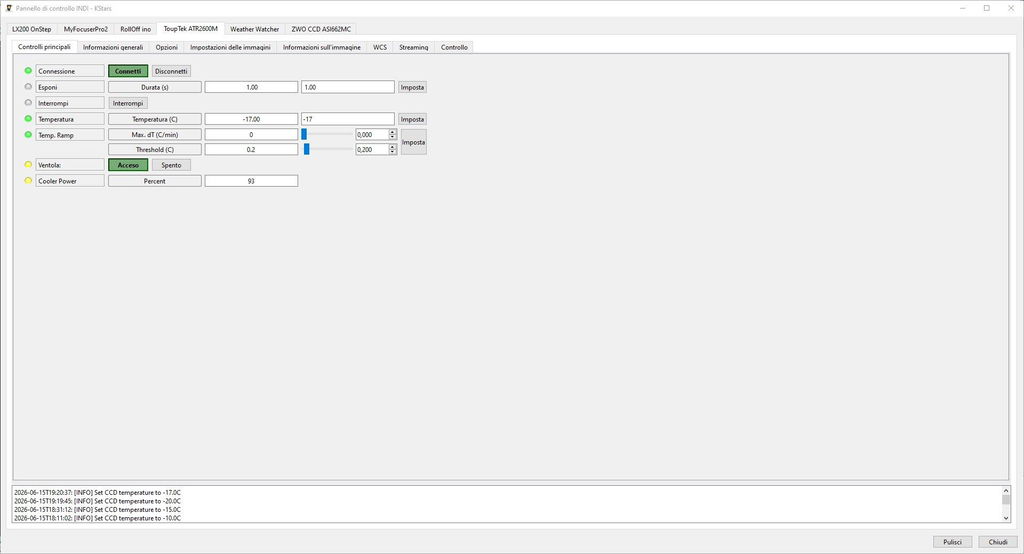
Yes. The ATR series features robust, industry-standard ASCOM and INDI drivers. It integrates seamlessly with all major open-source and commercial astronomy suites.

How do I achieve the standard 55mm backfocus with my telescope?

Achieving the industry-standard 55mm backfocus is precise and seamless. The optical train is configured via a modular three-stage connection sequence: a 17.5mm front adapter or tilter, a 20mm filter drawer or extension tube, and a 17.5mm Off-Axis Guider (OAG). This combination yields a perfect 55mm stack distance that connects natively to M48, M54, and M68 telescope interfaces, with simple adapter options available for M42 threads and 2-inch ports.

How does the Anti-Dew Technology work?

The ATR series utilizes a multi-layer defense system. The sensor chamber is industrially sealed with dry air to prevent internal frost. Simultaneously, a built-in electronic heating strip warms the protective window to prevent external dew under humid summer nights.