

1-Inch Sensor with 4.5 μm Pixels
The Sony IMX428M sensor combines 7.04MP resolution with 4.5 μm pixels, offering a balance of sensitivity, detail, and readout speed for planetary, lunar, solar, and deep-sky imaging.


High-Speed Monochrome Imaging for Planets and Deep Sky
ATR428M - ATR428M / US Plug ...は取り寄せ中で入荷次第発送します。
ATR Series cooled cameras require a stable 12V 3A DC power supply. Use the supplied adapter or a lithium-ion battery with a stable 11–14V output.
Shipping options and checkout-calculated delivery details are shown before payment.
For setup support, software downloads and warranty service, contact ToupTek Astro support with your order information.
Explore the details of planets, the Moon, and the Sun with the ToupTek ATR428M. Built around Sony’s IMX428M 1-inch global shutter sensor, it combines fast readout with a 512MB DDR3 buffer for high-speed image capture. Two-stage TEC cooling also supports long-exposure deep-sky imaging, making the ATR428M a versatile choice for astrophotographers who prioritize planetary imaging without giving up deep-sky capabilities.


The Sony IMX428M sensor combines 7.04MP resolution with 4.5 μm pixels, offering a balance of sensitivity, detail, and readout speed for planetary, lunar, solar, and deep-sky imaging.
Without a Bayer color filter array, the sensor captures incoming light directly at each pixel. This makes the ATR428M well suited to monochrome planetary imaging and, with LRGB or narrowband filters, detailed deep-sky photography.
The Sony IMX428M sensor delivers peak quantum efficiency above 79%, helping capture incoming light efficiently across a range of astronomical targets. Combined with its monochrome design, this makes the ATR428M well suited to planetary, solar, lunar, and deep-sky imaging, including narrowband imaging with appropriate filters.
If you enjoy imaging Jupiter, Saturn, Mars, or the Moon, the ATR428M’s global shutter and fast readout support high-speed capture. Record sequences of images and select the sharpest frames to bring out fine planetary and lunar details.
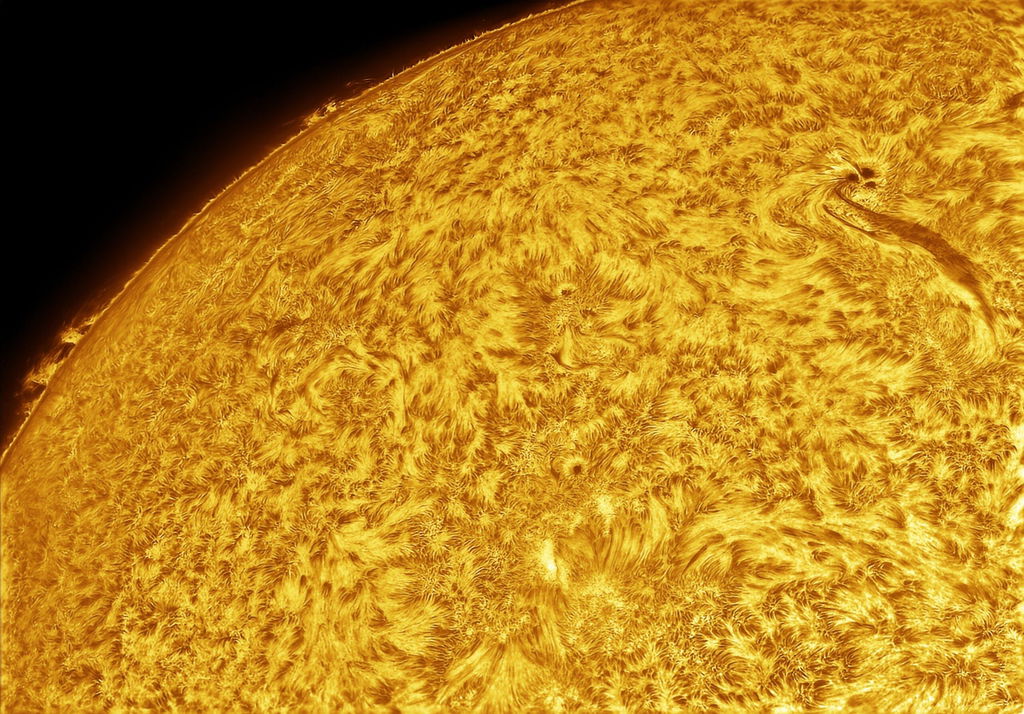
The monochrome sensor and global shutter make the ATR428M suitable for solar and lunar imaging with compatible optical systems and appropriate solar safety equipment. Its fast capture workflow helps you collect frames when atmospheric conditions are favorable.
The ATR428M is also capable of deep-sky imaging. Two-stage TEC cooling supports long exposures, while its monochrome sensor can be paired with LRGB or narrowband filters for imaging galaxies, star clusters, and nebulae.

High-bandwidth data transmission is secured by an onboard DDR3 buffer, preventing frame dropping, minimizing USB bus traffic bottlenecks, and ensuring ultra-stable image delivery even during fast frame rates or live rendering.

The ATR series optical window features an integrated smart heating system that actively measures ambient temperature and humidity. It automatically applies precise heat to prevent condensation, keeping your optical path crystal clear without introducing disruptive thermal air currents.

Equipped with an integrated heat dissipation structure and a high-efficiency dual-stage Thermoelectric Cooling (TEC) module with a controllable fan. It lowers the sensor temperature to 45°C below ambient, consistently maintaining a stable -5°C to -10°C even in peak summer. This allows for clean, long-exposure tracking up to 1 hour without thermal noise accumulation.

The global shutter captures the entire frame at once, helping reduce rolling-shutter distortion. This is especially useful for planetary and lunar imaging, where high-speed capture helps you collect more frames during moments of steady seeing.
The Sony IMX428M sensor offers strong sensitivity across the visible spectrum, extending into the near-infrared. This broad response supports planetary, lunar, solar, and deep-sky imaging, with added flexibility for capturing specific wavelengths using appropriate filters.
Which Series Do You Need
The ATR series features versatile sensors ranging from 1/1.2” up to APS-C (e.g., ATR585, ATR2600) to offer a balanced mix of performance and flexibility, whereas the flagship SkyEye Plus series incorporates APC-S (e.g., SkyEye26AM/AC Plus) and full-frame sensors (e.g., SkyEye62AM/AC Plus) to maximize light-gathering area and deliver expansive, uncropped fields of view.
Choose the acquisition workflow that matches your imaging goals
One-shot Color (OSC) cameras streamline your workflow by capturing full-color images without a filter wheel, offering a fast and travel-friendly setup that is perfect for astrophotography beginners, mobile imagers, or anyone seeking high-quality results with minimal post-processing.

Monochrome (Mono) cameras, however, deliver superior photon efficiency and pixel-level sharpness by eliminating the light loss and resolution interpolation of a Bayer matrix. Mono imaging is tailored for dedicated deep-sky astrophotographers who demand maximum sensitivity, ultimate narrowband performance (Hα, OIII, SII), and full control over composite LRGB rendering under any sky condition.


Yes. The ATR series cameras connect with accessories through USB data connection and stable external power, allowing users to build a complete deep-sky imaging workflow with a telescope, mount, guide camera, computer or controller, and power supply.
Yes. All ToupTek Astro DSO cooled cameras require a regulated 12V 3A DC power supply for imaging. Please use the included factory power adapter or a high-quality lithium-ion battery with a stable 11V–14V output.
Yes. The ATR series features robust, industry-standard ASCOM and INDI drivers. It integrates seamlessly with all major open-source and commercial astronomy suites.
Achieving the industry-standard 55mm backfocus is precise and seamless. The optical train is configured via a modular three-stage connection sequence: a 17.5mm front adapter or tilter, a 20mm filter drawer or extension tube, and a 17.5mm Off-Axis Guider (OAG). This combination yields a perfect 55mm stack distance that connects natively to M48, M54, and M68 telescope interfaces, with simple adapter options available for M42 threads and 2-inch ports.
The ATR series utilizes a multi-layer defense system. The sensor chamber is industrially sealed with dry air to prevent internal frost. Simultaneously, a built-in electronic heating strip warms the protective window to prevent external dew under humid summer nights.


